



Some jobs are straightforward to automate because they’re exactly the kind of work robots are good at, repetitive, physically demanding, and unforgiving of inconsistency. Stacking is one of them. Whether you’re handling concrete products, packaged goods, or bags and boxes, a Stacking Robot does the job reliably, without fatigue, and to a consistent standard every time.
Why Manual Stacking Is Worth Automating
Repetitive stacking is hard on people. It’s the kind of work that leads to fatigue and injuries over time, and it’s difficult to keep staffed because it’s physically demanding and not particularly engaging. When you automate it, you’re not just saving labour cost, you’re removing a genuine injury risk and freeing your people for work that actually needs them.
What a Stacking Robot System Involves
That might be stacking concrete pavers into packs, boxing bags of grain onto pallets, or stacking cartons of produce for dispatch.
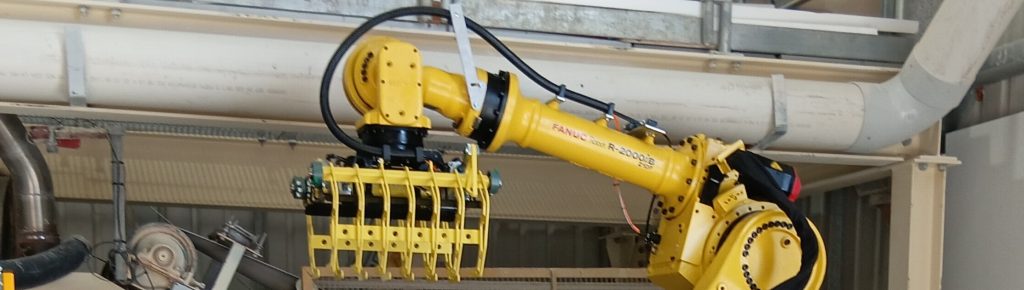
The engineering is in the details. End-of-arm tooling has to suit the product, vacuum, mechanical grippers, or custom tooling depending on what you’re handling and how it needs to be gripped. The robot program has to handle the stacking pattern, layer offsets, and any variation in how product arrives. And the whole cell needs to integrate with your conveyor system and meet safety requirements for an unattended or semi-attended operation.
At Automation Solutions & Robotics, we have direct experience designing and commissioning systems for product handling of various materials such as concrete products. We use Fanuc robots and handle the complete system, mechanical design, programming, PLC integration, and safety, so you’re not coordinating between separate contractors to get the job done.
Consistency That Matters Downstream
Inconsistent stacking causes problems further down the line, unstable loads, product damage, handling difficulties. A Stacking Robot places every product to the same position and orientation, which means your stacks are stable, your downstream handling is predictable, and you’re not dealing with damage caused by poorly built loads.
Running Continuously
One of the straightforward advantages of automation is runtime. A robot doesn’t take breaks, doesn’t slow down at the end of a shift, and can run through periods when manual staffing would otherwise require stopping the line. For facilities trying to increase throughput without increasing headcount, that continuous availability is a significant part of the value.
Is It Right for Your Application?
Stacking robot applications vary widely in complexity and cost depending on product type, throughput requirements, and how the system needs to integrate with your existing line. The best way to find out if it makes sense for your situation is to talk it through with someone who’s actually built these systems.
We’re based in Langwarrin, Victoria. If you’ve got a stacking or material handling application you’re looking at automating, get in touch for a straightforward conversation about what’s involved.
Learn more about our Industrial Robot Systems and what we’ve built for clients across Australia.