



There’s no shortage of articles telling you that industrial robotics and automation will transform your business. Most of them are written for a generic global audience and skip the part that actually matters: whether it makes sense for your specific operation, your product, your floor space, and your budget.
This is a straightforward look at what industrial robotics and automation actually involves, where it works well, and what to watch out for.
What ‘Industrial Robotics and Automation’ Actually Covers
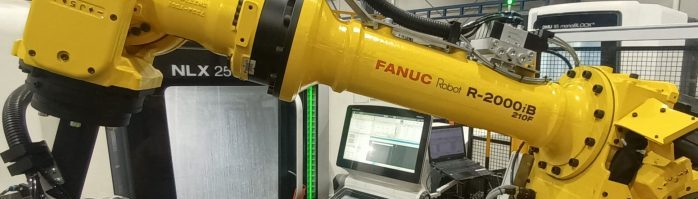
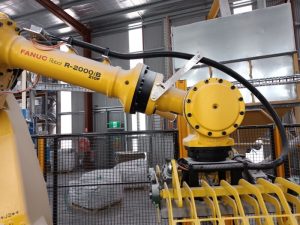
The term gets used broadly. In practice, for most manufacturers it means a robot arm, typically a Fanuc model, integrated into a production cell to perform a defined task repeatedly. Machine tending, palletizing, stacking, pick and place, welding. The robot handles the physical work; a PLC manages the logic and coordinates with the rest of the line.
The robot is one component. The rest is integration: conveyor systems, end-of-arm tooling, safety guarding, HMI, PLC programming. Getting all of that right is what separates a system that works from one that causes ongoing problems.
Where It Works Well
Industrial robotics and automation delivers the most value in applications that are high volume, repetitive, and consistent. If you’re running the same part or product in significant quantities, the return is straightforward. The robot runs overnight, through weekends, and doesn’t vary. Your output goes up and your cost per unit comes down.
It also works well for tasks that are genuinely hard on people. Repetitive heavy lifting, working near hot or hazardous equipment, high-speed repetitive motion. Automating those tasks reduces injury risk and turnover in roles that are difficult to keep filled.
Where to Be Realistic
Automation isn’t the right answer for every application. Low-volume, high-mix production with constantly changing parts can be difficult to justify. Products that vary significantly in size, weight, or orientation add complexity and cost to the tooling and programming. A straight conversation with someone who’s actually built these systems will tell you quickly whether your application is a good fit.
What the Integration Work Involves
At Automation Solutions & Robotics, we handle the complete system. Robot selection and programming (Fanuc), PLC integration (Siemens, Omron or Rockwell depending on your existing setup), end-of-arm tooling design, safety systems, and commissioning. You deal with one person throughout, not a chain of contractors who don’t talk to each other.
We’ve built systems for concrete product handling, CNC machine tending, and palletizing across manufacturing operations in Australia. The work is hands-on and site-specific, not a generic package sold off a shelf.
If you want to talk through whether industrial robotics and automation makes sense for your facility, get in touch. We’re based in Langwarrin and work with manufacturers across the region.
Learn more about our Industrial Robot Systems.
Frequently Asked Questions
How much space does a robot cell take up?
The robot itself takes up roughly the size of one pallet. Safety guarding options can be tailored to fit tighter layouts, including around columns, doorways, and awkward floor plans.
Can it fit in an awkward factory layout?
Yes. Every cell is custom-built to fit your space. We’ve worked around support columns, tight corners, split levels, and doorways.
What if my product mix changes?
Fanuc robots can be reprogrammed to handle different products, patterns, or tasks without replacing hardware. If your production changes, the system can change with it.
Do I need to understand robotics to operate it?
No. We design HMIs to be icon-based and intuitive. Your operators don’t need deep technical knowledge to run the system day-to-day.
What does ongoing servicing cost?
Minimal. An annual battery change keeps positioning memory intact, and routine maintenance is based on hours run. Fanuc technicians are available across Australia if needed.
Have more questions? Visit our full FAQ page.