



Palletising is one of the most common starting points for automation, and for good reason. The task is repetitive, physically demanding, and hard on your workforce over time. But the applications vary more than people expect. Cable drums are different to seed bags, which are different to cardboard sheet product. Here are three real installations that show what robot palletising looks like across different industries.
Tyree, Dandenong — Electrical Cable Drums
Tyree in Dandenong came to us with a clear goal: reduce the strain-related injuries their team were accumulating from manual cable drum handling. The challenge was space. The available footprint between the machine and the walkway was tight, and the cell also needed to accommodate operator access and pallet loading without blocking the path.
The system was designed around a Fanuc M20iA robot, well suited to smaller palletising applications with a 1,813mm reach and 0.08mm repeatability. The cell was built to handle various spool sizes and pallet configurations without hardware changes, and the HMI was set up so operators could select the right configuration without needing to call anyone.
The result was a cell that fit the available space, handled the product range, and removed the manual handling that was causing injuries.
Visy Board, Dandenong — Reutilised Robot Palletising Cell
Visy Board in Dandenong had an existing Fanuc robot that was no longer in its original application. Rather than purchasing new hardware, the project was built around reutilising that robot into a new palletising cell. The Fanuc W410i with an RJ2 controller had most of the required functionality still intact despite its age.
The cell was controlled by an Omron CJ2M PLC, with remote I/O on Ethernet I/P via Turck BL20 nodes. Dual ProFace HMIs gave operators control at two points on the line. The RJ2 controller was upgraded to meet current risk assessment requirements, and the Fanuc robot was brought onto a quasi Ethernet I/P communication level to integrate with the rest of the cell.
The reutilised robot approach isn’t always the right answer, but when the existing hardware is sound, it can deliver a working system at a fraction of new hardware cost. This project is a good example of that.
AGF Seeds, Regional Western Victoria — Seed Bag Palletising
AGF Seeds, a family-owned seed business in regional western Victoria, needed a palletising solution for seed bags of varying sizes. The main drivers were production rate and OHS risk from repetitive bag stacking.
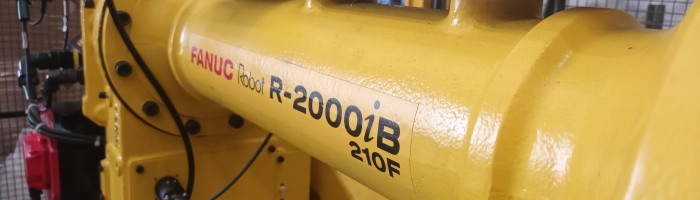
The system used a Fanuc R-2000iB/210F, chosen for its large working envelope, high payload capacity, and adequate speed for the application. The HMI-based recipe selection allowed operators to switch between bag sizes and pallet configurations without manual adjustments to the cell.
What These Three Have in Common
Different products, different industries, different constraints. But the approach was the same on all three: understand the specific application, design the tooling and cell around it, integrate the control system properly, and make it straightforward for the operators who use it every day.
At Automation Solutions & Robotics, we handle palletising projects as a complete system. Robot programming, PLC integration, tooling design, safety systems, and commissioning. One engineer throughout.
If you’re looking at palletising automation for your facility, get in touch for a straight conversation about what’s involved.
Learn more about our Robot Palletising Systems.
Frequently Asked Questions
What does a palletising robot cell cost?
Most of our robot cells range between $100k and $150k, fully installed. Conveyor infeed and custom tooling may add to this depending on your product and layout.
Can you reutilise an existing robot?
Sometimes. It depends on the robot model, controller age, and whether it meets current risk assessment requirements. We assess this as part of the initial conversation.
Can the system handle different product sizes?
Yes. We design cells to accommodate product variation through HMI-based recipe selection, so operators can switch configurations without hardware changes.
How long does installation take?
Most installations complete within 6 to 8 weeks. On-site commissioning typically involves around a three-day production pause.
Do you work in regional areas?
Yes. A significant part of our work is regional. We travel to site and provide remote support ongoing.
Have more questions? Visit our full FAQ page.