



Robot Palletising Victoria: Real Applications Across Victorian Manufacturers
Robot palletising is one of the most practical automation investments a manufacturer can make. The application is well defined, the return is measurable, and for businesses dealing with high volumes of repetitive end-of-line work, the case is usually straightforward. Here are two Victorian businesses that went ahead with it and what drove the decision.
Indoc Pty Ltd, Melbourne South East — Specialty Paint Production
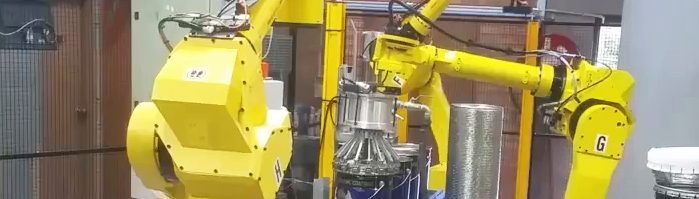
Indoc Pty Ltd is a privately owned business based in Melbourne’s south east that has been supplying specialty blended paints for over 30 years. They implemented Fanuc palletising robot cells to increase production rates, reduce OHS exposure, and reduce their reliance on external labour hire.
The labour reliability argument was a real one for Indoc. When you have production targets and someone calls in sick on a busy day, end-of-line palletising is often the first thing that backs up. A robot doesn’t call in sick. It runs when it’s needed and performs the same way every time.
The cell used Fanuc M710iC robots on Ethernet I/P fieldbus, with ProFace HMI for operator monitoring and control. A vacuum gripper with a Piab vacuum generator handled the paint product reliably without damage.
Tycab, Dandenong — Electrical Cable Drums
Tycab in Dandenong needed to reduce strain-related injuries from manual cable drum handling. The available floor space was tight, with the cell needing to fit between the machine and a walkway while still accommodating operator access and pallet loading.
The system was built around a Fanuc M20iA, well suited to the application with a 1,813mm reach and 0.08mm repeatability. The cell was designed to handle various spool sizes and pallet configurations without hardware changes, with a ProFace HMI for operator control.
Why These Businesses Chose Automation
Both projects had OHS as a primary driver. Manual palletising causes musculoskeletal injuries over time, and both businesses wanted to remove that risk before it became a workers compensation issue. The productivity argument was secondary but real in both cases — consistent output regardless of staffing, and the ability to run through breaks and shift changes without a drop in throughput.
Labour cost certainty was also a factor for Indoc specifically. When volumes fluctuate, a robot doesn’t require hiring and dismissing staff. The operating cost is fixed and predictable.
What a Complete System Involves
A robot palletisation cell is more than a robot arm. It includes conveyor infeed, end-of-arm tooling matched to your product, pallet handling, safety guarding, and PLC control logic that manages the full sequence and handles faults cleanly. At Automation Solutions & Robotics, we handle the complete system using Fanuc robots. One engineer throughout, no separate contractors.
If you’re looking at robot palletisation for your Melbourne or Victorian facility, get in touch for a straight conversation about what’s involved.
Learn more about our Robot Palletising Systems.
Frequently Asked Questions
What does a robot palletisation cell cost?
Most of our robot cells range between $100k and $150k, fully installed. Conveyor infeed and custom tooling may add to this depending on your product and layout.
How does it handle labour cost volatility?
A robot’s operating cost is fixed and predictable. It runs when you need it regardless of staffing availability, which removes the risk of production targets being missed because of sick days or difficulty finding casual labour.
Can it handle different product sizes?
Yes. We design cells to accommodate product variation through HMI-based recipe selection. Operators can switch configurations without hardware changes.
How long does installation take?
Most installations complete within 6 to 8 weeks. On-site commissioning typically involves around a three-day production pause.
Is it safe to run with staff nearby?
Yes, provided the cell is correctly designed. We build safety systems to Australian standards with risk assessment documentation provided at project completion.
Have more questions? Visit our full FAQ page.