



Robot Palletising: What It Is and Whether It Makes Sense for Your Business
Robot palletisng is the use of a robot to stack product onto pallets in a defined pattern, replacing the manual labour that would otherwise do it. That’s the simple version. The more useful question is whether it makes financial and operational sense for your specific situation.
What Drives Most Businesses to Automate Palletising
In most cases it’s one or more of three things: injury risk from repetitive heavy lifting, difficulty keeping the role staffed reliably, and the cost and quality variation that comes with manual end-of-line work.
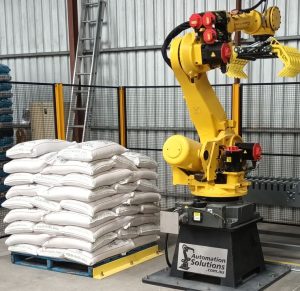
Home Hill Stockfeed, a family-owned business in northern Queensland supplying the farming industry, installed a palletising robot to solve manual bag filling and stacking processes that were creating OHS risks for their team. The robot took over the repetitive physical work, removed the injury exposure, and gave them more consistent output through the day.
Indoc Pty Ltd, a specialty paint manufacturer in Melbourne’s south east with over 30 years of operation, had a similar motivation. They implemented Fanuc M710iC palletising cells to increase production rates, reduce OHS risk, and reduce reliance on external labour hire. For Indoc, the labour reliability argument was key — when you have targets and agency staff don’t show up, end-of-line palletising is the first thing that backs up.
What the System Actually Involves
A robot palletising cell picks product from a conveyor infeed and places it onto a pallet in a defined pattern. Around that core function, you need end-of-arm tooling designed for your product, conveyor infeed, pallet handling, safety guarding, and PLC control that manages the full sequence and handles faults without requiring constant operator intervention.
The tooling is what most people underestimate. Bags, cartons, drums, and cable spools all need different gripper designs. Getting the tooling right for your product is as important as getting the robot specification right.
What to Assess Before Committing
Product type and weight determine the tooling approach and the robot payload requirement. Throughput determines whether the robot can keep up with your line — a robot that can’t match your production rate creates a new bottleneck rather than solving one. Floor space and layout are real constraints that need to be worked through before a quote is meaningful.
At Automation Solutions & Robotics, the assessment conversation happens before any design work. We look at your product, your throughput, your floor, and give you a straight answer about whether automation makes sense for your application and what it’s likely to cost.
The Financial Case
Most of the palletising cells we build range between $100k and $150k, fully installed. For most applications, payback is within two years through reduced labour cost and increased throughput. The cell is a depreciating asset and fully tax deductible. Leasing options are available.
If you’re considering robot palletising for your facility, get in touch. We work with manufacturers across Australia, including regional and remote operations.
Learn more about our Robot Palletising Systems.
Frequently Asked Questions
What is robot palletising?
It’s the use of a robot to stack product onto pallets in a defined pattern, replacing manual end-of-line labour. The robot picks from a conveyor and places to a pallet continuously without breaks or variation.
What products can be palletised by robot?
Most things. Bags, cartons, drums, cable spools, concrete pavers, paint tins. The tooling design changes depending on the product, but the application is very flexible.
What does it cost?
Most of our cells range between $100k and $150k, fully installed. Conveyor infeed and custom tooling may add to this. Payback for most applications is within two years.
Do you work in regional and remote areas?
Yes. We’ve installed systems in regional Victoria, South Australia, and Queensland. We travel to site and provide remote support ongoing.
How long does installation take?
Most installations complete within 6 to 8 weeks. On-site commissioning typically involves around a three-day production pause.
Have more questions? Visit our full FAQ page.
.