



An industrial robot palletizer is one of the most common entry points into automation for manufacturers, and for good reason. The application is well-defined, the return on investment is measurable, and the impact on your operation is immediate. But like any automation project, how well it works depends entirely on how well it’s been designed and integrated.
What an Industrial Robot Palletizer Does
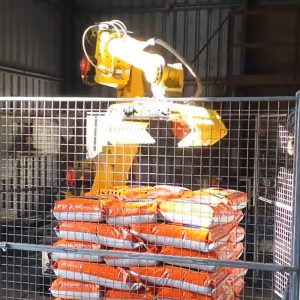
The function is straightforward: a robot picks product from a conveyor, places it onto a pallet in a defined pattern, and repeats until the pallet is full. A new pallet comes in, and the cycle continues. Done right, it runs through breaks, shift changes, and overnight without supervision.
The detail is in what surrounds the robot. Conveyor infeed, end-of-arm tooling matched to your product, pallet handling, safety guarding, and PLC logic that manages the whole cell and handles faults cleanly. That integration work is what separates a system that runs reliably from one that requires constant attention.
Payload and Reach Matter
Industrial robot palletizers are typically larger robots with significant reach and payload capacity. They need to build full pallet heights, handle product at speed, and in some applications, manage heavy loads. We’ve built systems for concrete product handling where the vacuum gripper was designed for a 45kg paver requirement and demonstrated on-site holding that load plus an additional 80kg on top with no yield. Getting the tooling and robot specification right for your product is non-negotiable.
Consistency Across Every Pallet
The productivity argument for an industrial robot palletizer is straightforward. The consistency argument is equally important. Every pallet built to the same pattern, the same layer height, the same orientation. Stable loads that don’t shift in transit. Product that arrives at your customer looking the same every time. For businesses where freight damage or load quality has been an issue, that consistency has direct dollar value.
Flexibility When Your Products Change
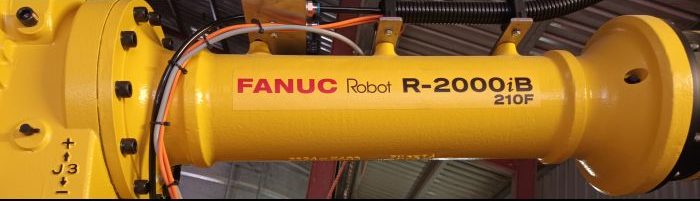
A concern we hear regularly is whether automating palletizing locks you into one product. It doesn’t have to. Fanuc palletizing robots can store multiple programs and switch between them at the operator’s selection. Different products, different patterns, different pallet configurations, handled by the same robot with a program change rather than a hardware change.
One Engineer, Start to Finish
At Automation Solutions & Robotics, we handle industrial robot palletizer projects as a complete system. Robot selection and programming, conveyor integration, tooling design, PLC programming (Siemens, Omron or Rockwell), safety systems, and commissioning. You deal with one person throughout, the same person who assesses your application, designs the system, and commissions it on your floor.
If you’re considering an industrial robot palletizer for your facility, get in touch. We’re based in Langwarrin, Victoria, and work with manufacturers across Australia.
Learn more about our Robot Palletising Systems.
Frequently Asked Questions
What does an industrial robot palletizer cost?
Most of our palletizing cells range between $100k–$150k, fully installed. Conveyor systems and custom tooling may add to this depending on your product and layout.
How long does installation take?
Most installs complete within 6–8 weeks. On-site commissioning typically involves around a three-day production interuption before the system is running and your team is trained.
Can it handle heavy products?
Yes. We design tooling specifically for your product and payload requirement. Our systems have been tested well beyond rated load requirements before sign-off.
What if we run multiple product types?
Fanuc robots can store multiple palletizing programs. Switching between products is an operator selection, not a hardware change.
Is it safe to run unattended?
Yes, provided the cell is designed correctly. We build safety systems to Australian standards, including risk assessment documentation at project completion.
Have more questions? Visit our full FAQ page.