



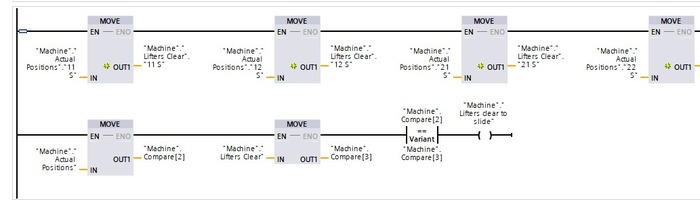
A Melbourne apartment building had a Hercules car stacker sitting dead. The original supplier had already been out, looked at it, and told the building manager to rip the whole thing out and start again. That’s an expensive answer when the mechanical structure, the hydraulics, the platforms, and even most of the original control wiring are all still sound. Melbourne Car Stacker Solutions took the job on a different basis: keep what still works, replace what doesn’t, and bring the parts that needed it up to a standard they should have had from day one. They brought us in to design and program the new control system. This wasn’t our first car stacker job with them, and the pattern is one we see often enough that it’s worth writing down.
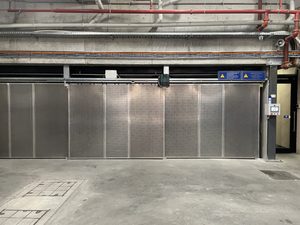
Why the system was condemned in the first place
The stacker used a Chinese-programmed PLC that was locked. No access to the program, no documentation worth trusting, and no way to modify or even properly diagnose the logic running the platforms. When a system like that develops a fault, or when a building wants to add a safety feature the original design never had, there’s nothing to work with. The condemnation wasn’t really about the mechanics. It was about a control system nobody but the original manufacturer could touch, and that manufacturer wasn’t answering the phone.
We see this pattern across other stacker brands too, not just Hercules. A locked or proprietary PLC turns a repairable mechanical fault into a total replacement recommendation, because the alternative, reverse-engineering someone else’s locked program, isn’t a sensible use of anyone’s money.
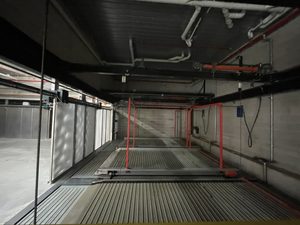
What we kept and what we replaced
The mechanical platforms, the hydraulic power units, and the structural steelwork were all still fit for purpose. So was most of the existing control wiring and the original control cabinet. Ripping all of that out would have thrown away the majority of the system’s value for no functional gain.
What we actually replaced was the locked PLC itself. It came out, and a remote I/O block went into the same cabinet in its place, wired into the existing field devices. The new Siemens PLC, in its own new cabinet, talks to that remote I/O over the network to run the whole system. A new SICK safety PLC was added at the same time to handle the safety-rated functions, and new safety gates went in at the platform access points, which the original system never had.
So the changeover wasn’t a total gut-and-replace. The original cabinet stayed in place doing what it always did, field wiring and I/O. What changed was the brain making the decisions, and the safety layer watching over it.
The result is a stacker that looks and moves the same to the end user, but now has a control system that can actually be maintained, diagnosed, and modified if the building’s requirements change, along with a much nicer interface for whoever’s operating it.
Adding safety gates to a system that never had them
This is the part that should concern anyone running an older car stacker. The original Hercules installation had no gating at the platform access points. That’s a real risk on a system where a platform can move while someone is standing in the bay. Retrofitting gates onto an existing mechanical structure means working with SICK safety relays or a dedicated safety PLC, tied into the new Siemens control logic so a gate opening actually stops platform movement rather than just triggering a light. On this job the safety PLC and the gates went in together, which is the correct order. Adding gates without properly integrating them into the safety logic gives a false sense of security.
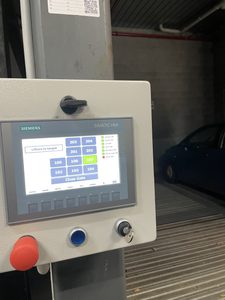
The Siemens HMI gives the building operator a live view of every safety input the system relies on, gates, e-stops, bumpers, slack rope detection, and floor sensors, all shown as a simple status list. If any one of them isn’t satisfied, the system won’t run. Most of the time, that status list is enough to sort out a fault over the phone, rather than needing a site visit.
The takeaway for building managers and body corporates
If you’ve got a car stacker with a locked or unsupported PLC, a condemnation from the original supplier doesn’t automatically mean the whole system needs to go. It’s worth getting a second opinion focused specifically on the PLC and safety layer, not the mechanics or the wiring behind it. On this job, the original supplier’s quote to rip out and replace the entire system came in around $400,000. Melbourne Car Stacker Solutions delivered the remedial works, keeping the sound mechanical components and as much of the existing control wiring as possible, and replacing just the locked PLC and safety system, for roughly a quarter of that price. Same outcome for the building, a fraction of the cost, and a system that can now actually be serviced instead of another locked black box.
Ready to talk about your car stacker?
If you’ve got a stacker system that’s been condemned, is on its last legs, or is running on an unsupported PLC, get in touch. No call centre, no upsell, just a straight assessment of what can be kept and what needs to change.
This kind of rebuild is a specific example of a broader PLC controls upgrade job. For the reasoning behind why code quality matters so much on jobs like this, see our piece on PLC code quality.
See our full machine safety system design services for more on how we approach safety PLC integration and retrofits.
FAQs
Can a car stacker’s PLC be replaced without replacing the whole system?
Yes, in most cases. If the mechanical platforms, hydraulics, and structure are sound, the PLC and safety system can be replaced independently. This is usually far cheaper than full replacement and gives you a system that can be properly supported afterward.
Why do some car stacker manufacturers use locked PLCs?
It varies, but locked or proprietary PLCs are common on imported stacker systems, particularly from manufacturers who want to control servicing themselves or who use configuration tools not sold outside their own network. It keeps ongoing service tied to that one supplier, which becomes a problem if that supplier is slow to respond or exits the market.
Do older car stackers need safety gates by law?
Requirements depend on the state and the specific installation, and this isn’t something to guess at. If your stacker doesn’t have gating at platform access points, it’s worth getting a safety assessment against current standards rather than assuming the original installation is still compliant.
What’s the difference between a standard PLC and a safety PLC?
A standard PLC (like the Siemens unit used here) runs the general control logic, moving platforms, sequencing, and monitoring. A safety PLC (SICK, in this case) is a separate, safety-rated system specifically for functions like gate interlocks and emergency stops, built to a higher reliability standard and independently certified for that purpose.
How long does a car stacker control system upgrade take?
It depends on the scope, the number of platforms, and whether safety gates or other mechanical additions are involved. A control and safety system replacement on an existing structure is typically much faster than a full stacker replacement and installation.
More questions answered on our full FAQ page.