



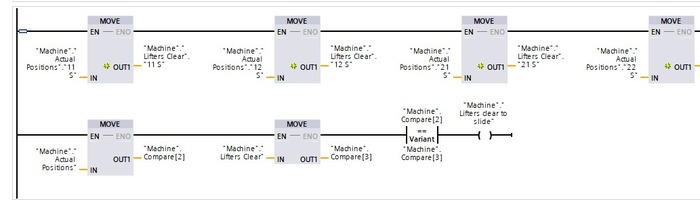
Search “PLC programming Melbourne” and you’ll find a page of businesses telling you they have a team of experts, decades of combined experience, and a commitment to excellence. What you won’t find much of is who actually writes the code, or what’s actually been built. Automation Solutions & Robotics is a sole-operator business, run by engineer Brett, who writes and commissions every PLC program directly. No handoffs to a junior, no call centre answering the phone, no account manager between the client and the person doing the work. This page is about what that looks like on real jobs.
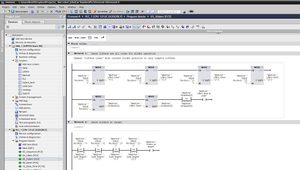
What most PLC jobs are actually like
Most PLC work isn’t glamorous and it isn’t generic either. It’s a locked cabinet on a machine nobody can get parts for. It’s a safety system that was never properly integrated. It’s a control philosophy that made sense to whoever wrote it ten years ago and to nobody since. Every job starts with understanding what’s actually there, not what the drawings say should be there, because the two often don’t match after a decade of patch fixes.
Work covers the platforms Melbourne manufacturers actually run: Siemens TIA Portal, Rockwell Studio 5000, and Omron, along with safety systems from Siemens, Omron, SICK, and others. A mix of brands from different installation eras on the one site is normal, not a special case.
Real jobs, not hypotheticals
A few examples of what this actually looks like in practice:
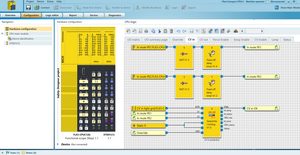
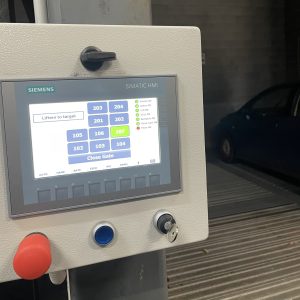
- A Hercules car stacker in Melbourne that its original supplier condemned and quoted around $400,000 to fully replace. The mechanical structure and most of the control wiring were still sound. The locked PLC was replaced with a Siemens unit talking to the existing cabinet over remote I/O, a SICK safety PLC was added, and safety gates were retrofitted where the original system never had any, for roughly a quarter of that price.
- A baghouse valve sequencer built from scratch in TIA Portal, with configurable cycle, step, and valve-on timers, now running confirmed and working across 16 valves.
- A two-robot cell where one FANUC robot tends a moulding machine and feeds parts through a shot blaster, and a second robot palletises the finished product, with conveyors designed and built in-house to link the stages together.
These aren’t case studies written up by a marketing team from a project brief. They’re real jobs, delivered start to finish by the person who wrote the logic and commissioned it on site.
Why so much PLC work ends up locked or unsupported
A lot of the PLC problems that come up aren’t really PLC problems, they’re the result of a system nobody documented properly, or a proprietary platform that only one supplier can touch. When that supplier stops answering the phone, or the person who wrote the original logic has left the business, a straightforward fault turns into a full system replacement recommendation, because nobody else has anything to work from.
Good PLC programming should leave a plant less dependent on any single person or supplier, not more. That means proper documentation, clear tag naming, and structured logic that the next person, whoever that ends up being, can actually follow. Every job is built that way, because eventually somebody else is going to have to open that program.
What working with one engineer means
No call centre triage before reaching someone technical. No quote written by a salesperson and handed to a programmer who’s never seen the site. The problem gets explained once, to the person who’s going to fix it. If something changes on site during commissioning, which it often does, the same person who understood the original brief is the one adjusting the logic.
It also means straight answers about what’s actually worth doing. If a locked PLC can be worked around instead of replaced, that’s what gets recommended. If the mechanical system is sound and only the control layer needs attention, that’s what gets quoted, not a full system replacement because it’s a bigger job.
Ready to talk about your PLC system?
If you’ve got a PLC system that’s locked, undocumented, or just needs updating to something you can actually maintain, get in touch. No call centre, no upsell, just a straight assessment from the person who’ll be doing the work.
Code quality is what separates a system that lasts from one that doesn’t, see why PLC code quality matters. For Siemens-specific systems, see our Siemens PLC programming work.
See our full PLC programming services for more on the platforms and project types we cover.
FAQs
What PLC brands do you work with in Melbourne?
Siemens TIA Portal, Rockwell Studio 5000, and Omron, along with safety systems from Siemens, Omron (including G9SP), SICK, and others. A site running a mix of these from different installation eras is a common situation, not an unusual one.
Can you work with an existing PLC system instead of replacing it?
Often, yes. If the PLC itself is locked or unsupported but the mechanical and wiring side of the system is sound, it’s usually possible to replace just the PLC and safety layer rather than the whole system. That’s not always the case, but it’s always worth assessing before assuming a full replacement is needed.
Do you handle safety PLC integration as well as standard control logic?
Yes. Safety PLCs are a separate, safety-rated system from the standard control PLC, and they need to be properly integrated so safety functions actually stop the machine rather than just displaying a warning. This is a core part of the work, not an add-on.
How do you handle documentation and handover?
Every program is built with structured logic and clear tag naming, with documentation provided as part of the job. The goal is a system that someone else can understand and maintain if needed, not a black box that only makes sense to the person who wrote it.
Do you only work on robot cells, or standard PLC and HMI jobs too?
Both. FANUC robot integration is a specialty, but the majority of PLC and HMI programming work is standard industrial control: machine safety systems, conveyor and sequencing logic, and upgrades to existing plant, independent of whether a robot is involved.
More questions answered on our full FAQ page.